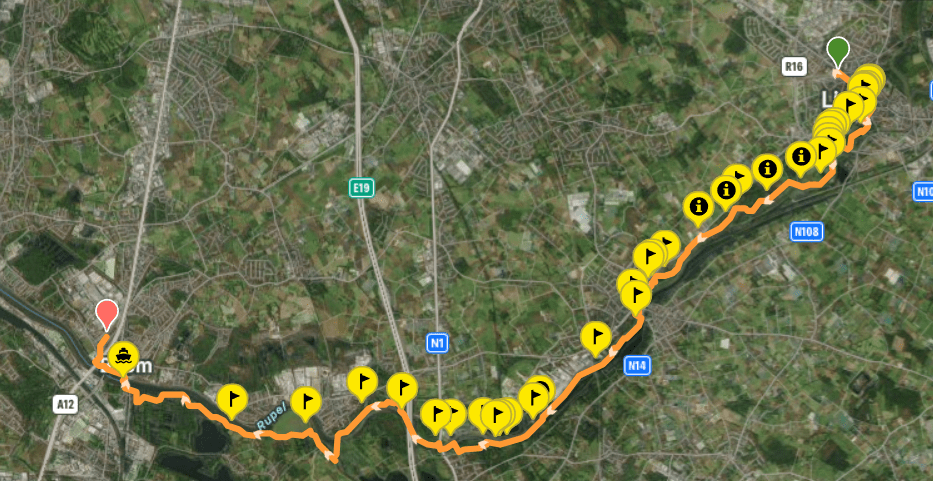
In preparation of multiple day hiking trips I boarded a train. In the Lowlands we have a concept ‘treinstapper’, take the train to a certain destination, hike wherever you like (mainly parks and greenways – we call them “slow roads” as motorized vehicles are not allowed) and take the train back home. The word ‘treinstapper’ is self-explanatory since the Dutch language loaned ‘trein’ from English and ‘stapper’ entered the English language via Germanic influence.
Train has a fascinating etymology with different meanings over time.
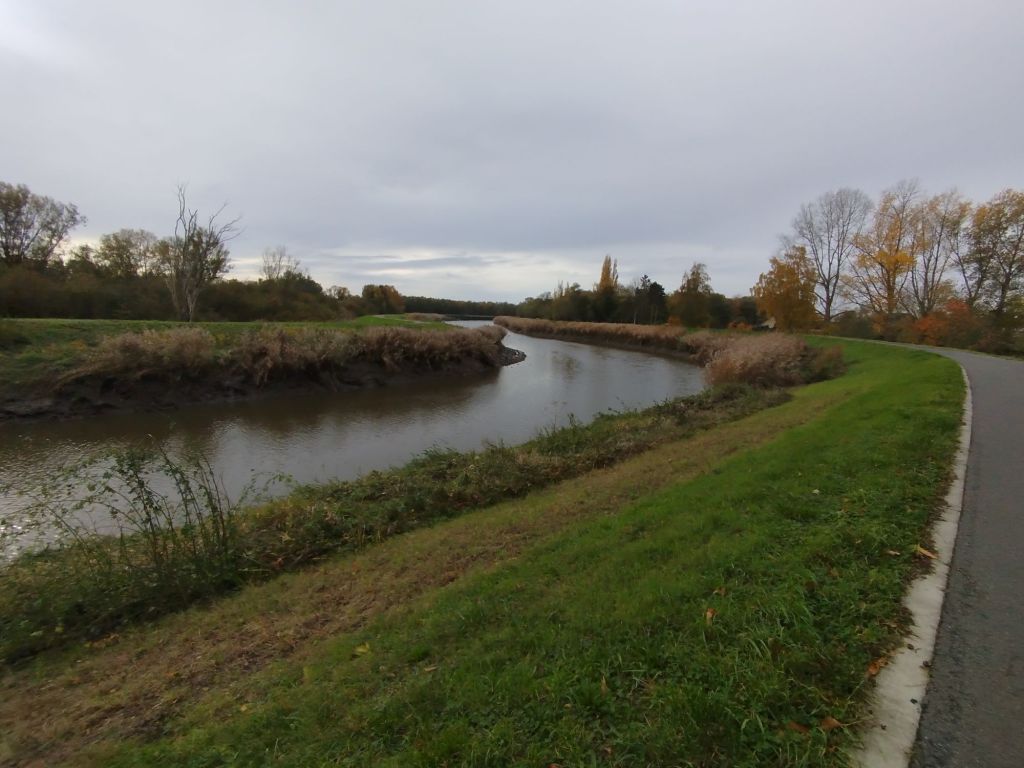
I believe it was my first visit to the Medieval city of Lier. The city is linked to (Belgian) Saint Gummarus. The red figure left of Lier is their nickname: sheep’s heads. If you want to know why, read here. After military campaigns (and perhaps his wife) he had enough of humanity, I assume. The city grew up around his hermitage. Stories, legends, folk tales can be easily found on the www. Duke Henry 1 of Brabant granted Lier city rights in 1212. Thanks to textile industry many regions in the Lowlands boomed in 12th and 13th century. And then the 80 Years’ War happened, I know, a recurring theme and it was a temporary downfall for current Belgium and the Netherlands. Lier bounced back thanks to their cattle market, breweries and textile factories. In 1580s English a lier-by was a mistress. Also no links to the word lyre (lyrical) derived from Latin Lyra which is also the Roman name given to the city. A nationally renowned author and poet described Lier as “where three meandering Netes (river) tie a silver knot”. The Big Nete and Small Nete become the (Nether-)Nete.
I barely took any photos in the city as it was their annual November funfair. This one above is also pretty famous, the Zimmer tower with its many dials.
Next port of call is Duffel (yes, you do recognize it, don’t you). Celtic presence might indicate that the town’s name was given by them, “Dubro” meaning water. Just like Lier, many artefacts were discovered but from times when writing was deemed not important or non-existent. Duffel got immortalized worldwide for the coarse woolen cloth. Or rather thanks to the English language. I don’t see anyone asking for a “duffeljas” (jacket) or duffeltas” (bag) in Dutch shops…
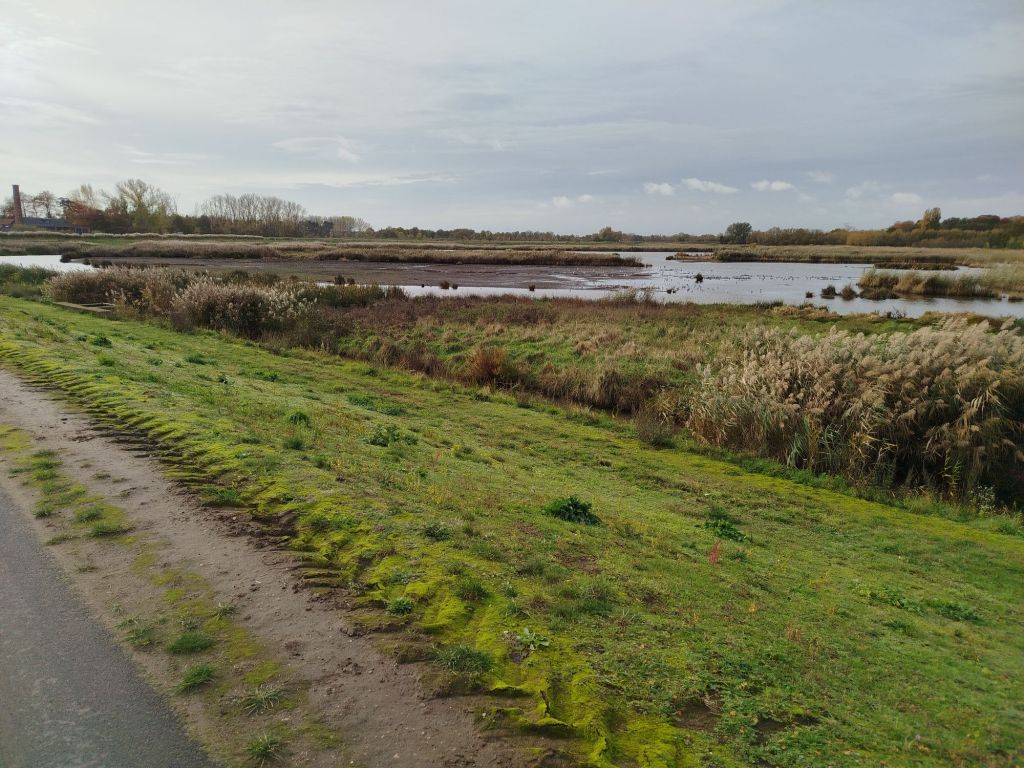
From the textile industry I venture into brickmaker’s territory. Obviously both requiring a continuous flow of water, the latter also needs clay. Does it surprise anyone that many fishing clubs are present? The many claypits have been repurposed as ponds and nature sites. Plenty of efforts were needed since – back in the day – the pits were used to dump all sorts of trash, including asbestos. The soil is still being monitored.
And last in line is Boom. Like Rumst, Boom is famous for its bricks. I have written about Boom here.
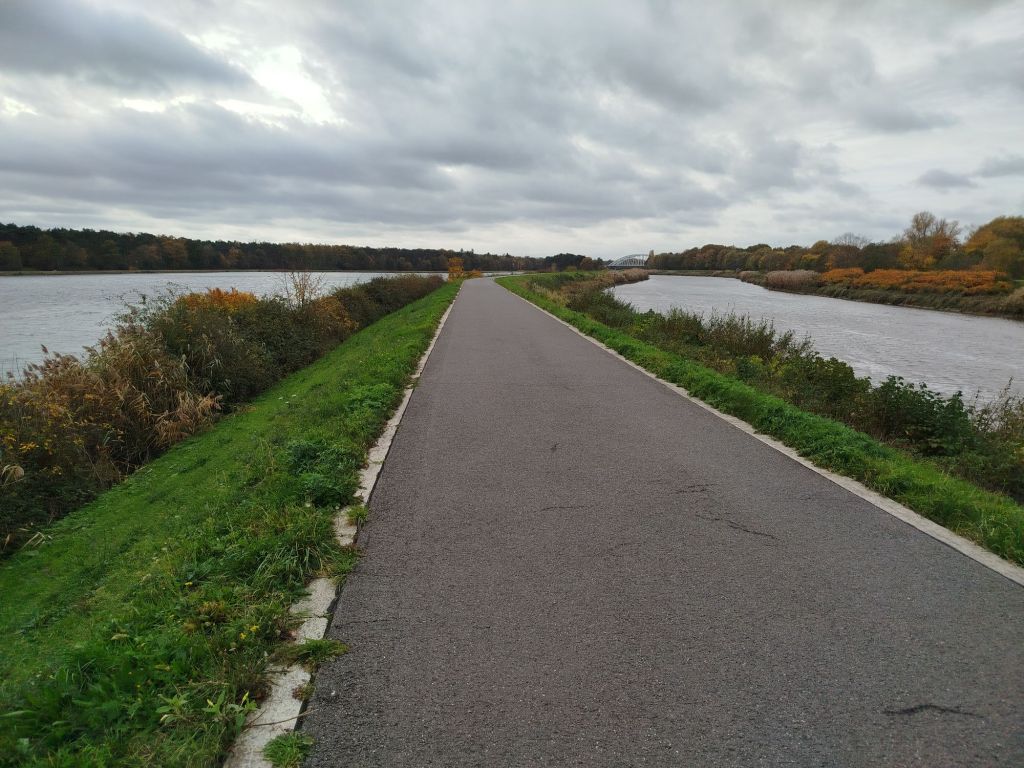
The hike was just over 15.5mi and I ended up crossing the river by ferry boat (notice similarities with the Dutch ‘veerboot’?). No, the verb to veer is from French. In Dutch we have adjusted veder to veer. In English the word transformed to feather. Neither feather nor veering is relevant. Language and its evolution can be rather confusing but it keeps me occupied on the road. The scenery was stunning though and many areas have been re-designated to flood plains.
In Belgium we have a saying: A Belgian is born with a brick in his stomache. Just to say everyone wants to build his or her own house. The brickmaker’s industry requires much less (human) manpower and plenty have found out – the hard way – that you simply cannot build wherever you want. A colorful history mixed with life lessons.
A truly fascinating region wedged between capital Brussels and Europe’s second largest port: Antwerp.
In case you want to walk the Camino, and opt for Via Brabantica, you will pass by this region (if you choose the original route and not a shortened version).
What do Celts, Vikings (+ Norse mythology), French aristocracy and Germanic tribes have in common? They all contributed to Modern English. It’s quite amusing when a language evolved over time and is an amalgamation of several languages and cultures. And then you have an influential person that wants to restrict foreign influence into said language… Hence a little introduction how English was formed as we know it today.
Introduction
English is not my first language. As a Belgian, it is actually my fourth. Although, in all honesty, I should rank English second based on proficiency and fluency.
Perhaps having a Germanic language as mother tongue helps learning English and German.
Background
You may know that not only the country of Germany speaks Germanic language. The borders of what used to be German territory and even colonialism (as for most European language spread over the world) are to blame. Interestingly only (or as good as) the English use the word Germany. Hence the confusion, since West Germanic language Dutch and German were once used as synonyms in the region. In Dutch we called current “Nederlands” Diets and the German version Duits. Then again, both were used interchangeably as the language was – back then – very similar. In Dutch we named the country of the “Duits”-speaking people Duitsland. The English of course complicated all this by calling “Nederlands” Dutch. Just like the Germans call the language Deutsch and their country Deutschland. Not to mention the funny variations of the country’s name. I am looking at you Slavic people.
Some languages use the old tribe’s name of Allemani, Germani or even Saksen (Saxons). The Slavic languages refer to Germans are “mute” or “unable to speak”. Similar to the Roman approach that everyone not Roman(ized) was a barbarian.
English is born
When do you pinpoint when a language starts? Do you really have to start from the root language PIE (Proto Indo-European) on the Black Sea shores? I will leave the languages family tree and details to linguists and historians.
Have you ever heard of Ingvaeonic? Aka North Sea Germanic?
The point where I like to start, since it bears so many similarities are the Anglo-Saxons, Frisians and Jutes. Certain English people like the term ‘Anglo-Saxon’ very much but the same people seem to forget those two tribes/people were of “foreign” origin. Quite surprising they still use the “Briton” but have completely denounced their Celtic heritage. I can only imagine it is mainly thanks to the Romans.
The Angles (people) hailed from current Denmark/Germany border region, Saxons are German and the Frisians span from Germany over the Netherlands into Belgium.
From the Anglo-Saxons, Frisians and Britons cultural mix, and perhaps even noteworthy to mention that there was something like Romans once upon a time. And a change in religion, the number of gods were drastically reduced.
Later influences
From 800-950 the language assimilated Old Norse, as you will know, if you ever watched Viking series. At the same time there was a simplification of Old English grammar. If you want to learn about the Norse (aka Northern Germanic languages) influence in the English language, you should definitely check your weekdays and toponymy of English towns and cities. Old English is barely comprehensible to a majority of people nowadays as it is written in runes and 85% of vocab no longer in use. Old English is probably more understandable to a modern German speaker.
About 1066, quite a well known date in English history sort of marks the transition to Middle English. It should not come as a surprise that many words concerning conflict are of Norse influence.
Middle English changed quite a bit for the language. At the end of the Middle English period, from 1400 to 1600, the Great Vowel Shift happened.
At the same period the English language (through the British Empire) was “exported” worldwide. Perhaps this indicates why English dialects are perceived as strange. Especially since the language was going through some changes. If you know about Madagascarian/Malagasy fauna you are probably aware that isolation affects evolution differently than in Eurasia, Africa or Americas.
Royalty introduced the French language into English. Some kings barely spoke English. In Dutch people eat, just like the English peasants “calf” whilst the aristocracy ate “veal”. Therefore the English having two words: one for the animal, one for the food.
Do you say royal or kingly? Paternal or fatherly? Amorous or lovesome? Dictionary or wordbook? Blond(e) or fair(-haired)? Do you ponder or wonder? Science or knowledge? Escape or flee? Port or harbor? Reply/response or answer? Chase or hunt? Property or owndom/belongings? People or folk? Valuable or worthy? Abandon or forsake? Distance or span? Incredible or unbelievable? Despair or hopelessness? Do you resist or withstand? Ire/rage or angry/wrathful? Severe or stern? Enemy or foe? Tomb or grave? Zero or Nought? Ridiculous or laughable? Assume or foreguess? Yes, I realise nowadays they are not always synonyms.
Have you ever wondered where synonyms come from? Don’t you believe one word is easier? That is the beauty of amalgamation. Problems arise when synonyms, perhaps just very subtly, change slightly in definition.
Modern English started about 200 years ago. Reading a book from the early ME might be challenging though.
Unsurprisingly languages evolve even faster since the invention of the internet. Well, actually it already started with Hollywood.
In non-English languages is an enormous influx of English words and expressions (cringe, rizz, etc) but also other languages. American-English will have more Spanish influences whilst Aussie/NZ will have more Asian.
So, what now?
Are we going to lock in a language and denounce every foreign influence? I remember a time (in my youth) when people were looking for Flemish/Dutch equivalents for English words (like computer, download, soft/hardware). I assume it was more hilarious than a serious attempt to save our language from English influence. Imagine the replies of the public who came up with a Dutch alternative for a floppy-disk? Quite ridiculous when you realize that computare is of Latin origin. Also in the Lowlands we a similar story language-wise.
Funny how some people are xenophobes but have no problem devouring “foreign” food. The look on the faces of islamophobes is priceless when you explain the origins of Spain’s national dish paella.
I don’t understand how tourists can travel abroad and only eat food they know. In Dutch we have a proverb roughly translated like:
What the farmer does not know, he does not eat.
Obviously metaphorically. Often I wonder what happened when European people were introduced to potatoes, chocolate (originally so not the later sugar rush version) and many other fruit&veg, spices, etc. If you restrict your diet to produce what is native to the land as well as locally produced, you certainly will have to take supplements. Especially in the US where farmers usually specialize in just one product. In comparison, in Europe you have many farmers opening a shop (and vending machines) selling a range of local produce. Oftentimes even cheaper than in the local supermarkets.
Anyways, what’s next? Have you ever heard about Cockney rhyming slang? Just to say that dialects were used or created to identify if a person was part of the community and hence to be trusted. As if all danger and risk came from outside. Nowadays crime fighters always look to non-strangers first. According to statistics people should change their view on who to trust. Strangers are statistically safer to be around. I realize this is against our instincts. I assume psychologists and psychiatrists will have a decent explanation.
I’d rather want to talk to a stranger, someone from another country or region, or someone showing an interest in the region; than so-called locals. Strangers (usually) have a more open mind, have more appreciation and respect than locals.
Languages were never a(n) (major) obstacle. Traders on the silk road were most probably proficient in many languages. Apparently Marco Polo knew four languages.
PS: Does anyone know why white people in other countries are known as “expats” (even if they have no intention to return to their hoe nation) whilst non-whites indiscriminately “migrants”?





 Celtic Belgae